Increasing slider to imagines that times as much wind power was installed, generating as much output as what the grid actually recorded.
We have ANSWERS for you!
How much with 'Net Zero' really cost? Are UK clean energy plans credible? Could batteries make renewables reliable? What about alternatives? find answers to these and much more with our unique grid model.
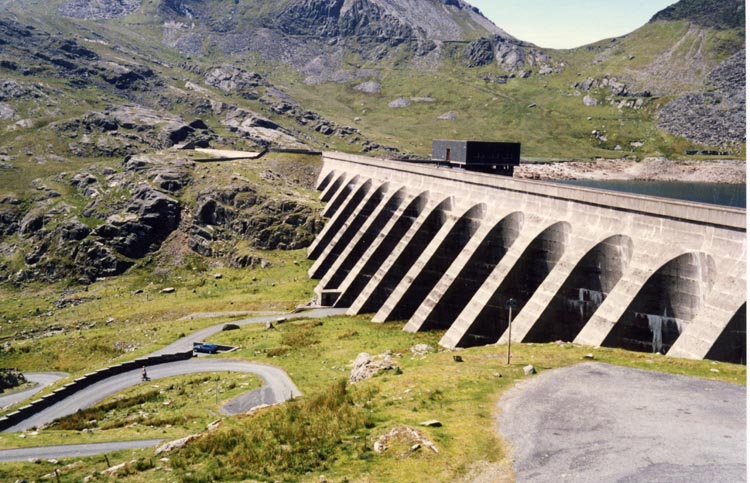
Photo: Pumped Storage dam
(WikiMedia/
Arpingstone)
The model reveals that the biggest problem to solve for a clean energy grid is likely to be long duration energy storage, that has to store vast amounts of energy, yet only be used once or twice a year.
Photo: Pexels /
Tuấn Nguyễn Văn
Step (2) - Add storage
Stockpile surplus electricity using batteries or other storage to use when needed later
Use the sliders to add battery storage:
How our model calculates storage
When supply exceeds demand and there is electricity spare, we add it to storage. When the renewables are low and the grid needs more juice, we subtract the shortfall from storage and add it back to supply, minus a proportion for round-trip inefficiency.
GW or GWh?
What's the
difference?
Step (3) - Adjust demand
UK needs to double electricity supply
Just 19% of the UK's energy comes from electricity today. 45% is from petroleum products (mostly in
transport)
, and 29% from natural gas used for
heating.
Electrifying heating and road transport, which are both three times more efficient, will double UK electricity demand.
Data from
Gov.UK
Transitioning to electric heating and road transport will increase demand on the grid
Electrify Road Transport?
Electrify heating (phase out Natural Gas)?
Adds massive load to grid, mostly during winter. The only way to reduce this is to lower demand through energy efficiency:
Insulation1
in of homes
Heatpumps2
in of homes
STORAGE CAPACITY - GWh -
STORAGE POWER - GW
Electric heating and vehicle charging will make huge contributions to slashing the UK's carbon footprint, but they are forecast to double the UK's current electricity needs.
The next steps look at different kinds of storage, and testing over a much longer period
Step 4 - Optimise Storage
This model uses three main
storage technologies Batteries - Very expensive, cost is determined by the amount of energy stored, but can be up to 90% efficient
Pumped Storage Hydro - also expensive, costs depend on size of reservoir (amount of energy) and the power of turbines. 85% efficient
Hydrogen - electrolysers to make hydrogen and CCGT (turbines to turn it back into electricity) are both relatively cheap, and the amount of energy stored could be almost limitless. However, at least 60% of the precious electricity is wasted during the processes of converting to hydrogen and back to electricity.
WIND
SOLAR
NUCLEAR 1
Elec ROADS?
Elec HEATING?
INSULATION
HEAT PUMPS
STORAGE
POWER
CAPACITY
BATTERIES
£ 0Bn
PUMPED STORAGE
£ Bn
HYDROGEN 2
£ Bn
CCGT
3
V2G
4
Stored energy
Stored energy (in Thousand GWh): Hydrogen stores (Graphs 2) Battery, Pumped Storage and V2G stores (Graph 3):
Step 5 - Select Dates
This simulation can cover a time period up to 1 year
Use the black 'bar' sliders to set start and end dates
👈 ADJUST 👉HERE
<=Adjust start/end dates => (sliders)
Use the two date-zoom sliders above to adjust start and end dates.
The basic looks at a whole year's data, but there are actually
10 years of data
available (from 2015 onwards) detailing over 175,000 data periods soon to be developed.
Why to leave out other technologies that could play a role in an electricity grid powered only by renewables:
Interconnectors
Interconnectors linking the UK to other national grids on the continent currently make up a significant share of the UK's electricity. However, if all those other grids also rely on wind and solar, they may not be available to supply power just when the UK needs it. For that reason, this model excludes contributions from interconnectors.
Demand response (also called load shifting)
Shifting power-hungry devices (car charging, heat pumps, industrial processes) to off-peak hours will undoubtedly play an important role in smoothing out the peaks and troughs in demand for electricity (in a very similar way to batteries), but it doesn't address the bigger problem of long term energy storage.
Tidal power
Studies have proposed that tidal barrages could supply up to 7GW of electricity, reliably, for many decades. Similarly tidal flow schemes promise predictable reliable power akin to baseload. But the numbers are too small to contribute significantly to the UK's power supply.
Small Modular Nuclear Reactors
The promise that small modular reactors will be cheaper than large reactors looks like magical thinking to me. I'm not an expert, but the potential savings from the 'modular' construction approach seem less significant than the economies of scale that a single large reactor can deliver. Take the experience of Nu-Scale Power. Its costs ballooned three-fold, even after the project was scaled down in size before being cancelled at huge costs to Idaho consumers. That SMR suffered exactly the same massive cost over-runs as large projects such as Hinkley Point, Flamanville, Vogtle, etc.
The numbers behind the model
See the calculations in action,
Add dynamic info under each type of current max GW & GWh